

Key takeaways
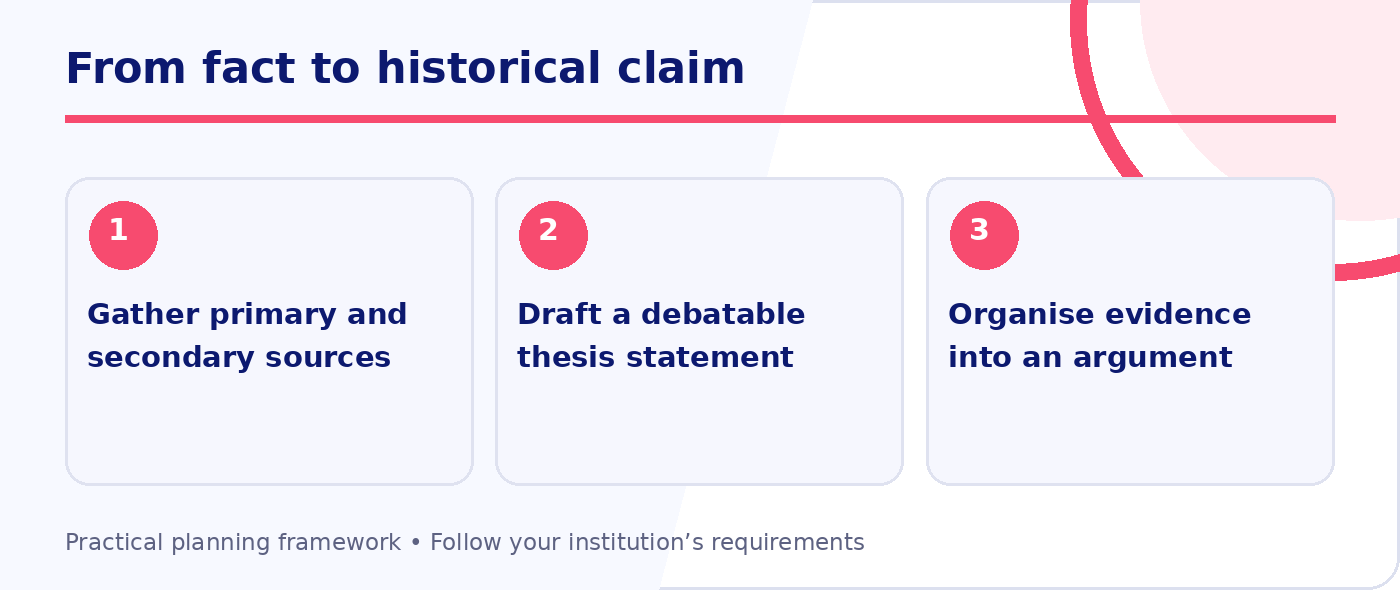
- Understand the NHD thesis: For National History Day (NHD), a thesis is a defensible historical argument that responds to the annual theme.
- Choose a specific historical question: Start with a time, place, event or individual and ask what changed, why it mattered and which evidence could support competing interpretations.
- Gather primary and secondary sources: Primary sources may include letters, newspapers, photographs, speeches or official records created in the period.
- Draft a debatable thesis statement: A descriptive statement says what happened.
- Organise evidence into an argument: Build sections around reasons supporting the thesis rather than around a chronology alone.
Introduction
A successful academic project begins with a clear purpose, suitable evidence and a realistic plan. This guide explains the decisions that matter most for nhd thesis writing guide: a step-by-step roadmap to academic success. It offers practical examples, critical cautions and checklists that you can adapt to your course requirements.
UK institutions may use different assessment criteria, ethics procedures and referencing rules. Always check your current handbook and discuss any uncertainty with your supervisor. The examples below are illustrative, not findings from original empirical research.
Understand the NHD thesis
For National History Day (NHD), a thesis is a defensible historical argument that responds to the annual theme. It is not simply a topic label or a list of facts. Check the current NHD rule book and theme guidance before finalising your claim.
NHD is a history competition context, not a UK university dissertation format. If your assignment uses the acronym differently, follow the rules issued by your teacher or institution.
Practical action: write a short note explaining how this decision applies to your own project. Identify one credible source or piece of evidence that supports the decision, one limitation, and one question to raise with your supervisor. This small audit makes your reasoning easier to defend and helps prevent avoidable revisions.
Figure 1. NHD research pathway.
Choose a specific historical question
Start with a time, place, event or individual and ask what changed, why it mattered and which evidence could support competing interpretations. A narrow question is easier to argue than a sweeping statement about an entire century.
Make sure your proposed claim is not already assumed in the question. Historians must be willing to revise interpretations when primary evidence complicates an initial idea.
Practical action: write a short note explaining how this decision applies to your own project. Identify one credible source or piece of evidence that supports the decision, one limitation, and one question to raise with your supervisor. This small audit makes your reasoning easier to defend and helps prevent avoidable revisions.
Gather primary and secondary sources
Primary sources may include letters, newspapers, photographs, speeches or official records created in the period. Secondary sources interpret the past using evidence and scholarship. Both are important, but they serve different roles.
Evaluate authorship, intended audience, date, purpose and what the source cannot tell you. A newspaper headline is evidence of a publication’s framing, not automatically evidence that its claims were true.
Practical action: write a short note explaining how this decision applies to your own project. Identify one credible source or piece of evidence that supports the decision, one limitation, and one question to raise with your supervisor. This small audit makes your reasoning easier to defend and helps prevent avoidable revisions.
Figure 2. Source credibility questions.
Practical comparison
| Stage | Output | Quality check |
| Question | Specific historical problem | Defined time and place |
| Evidence | Primary and secondary source log | Provenance checked |
| Thesis | Defensible interpretation | Supported by sources |
Draft a debatable thesis statement
A descriptive statement says what happened. An argumentative thesis explains significance or causation and can be defended with evidence. For example, replace “The campaign happened in 1963” with a claim explaining how particular strategies affected a defined outcome.
Avoid claiming a single event caused every later development. Strong historical arguments acknowledge multiple influences and define the scope of the claim.
Practical action: write a short note explaining how this decision applies to your own project. Identify one credible source or piece of evidence that supports the decision, one limitation, and one question to raise with your supervisor. This small audit makes your reasoning easier to defend and helps prevent avoidable revisions.
Organise evidence into an argument
Build sections around reasons supporting the thesis rather than around a chronology alone. Context explains what readers need to know; analysis shows how sources support each claim.
Use transitions to explain how one point leads to the next. Include counterevidence and explain why your interpretation remains persuasive, rather than ignoring inconvenient material.
Practical action: write a short note explaining how this decision applies to your own project. Identify one credible source or piece of evidence that supports the decision, one limitation, and one question to raise with your supervisor. This small audit makes your reasoning easier to defend and helps prevent avoidable revisions.
Planning and quality-control table
| Check | What to record | Why it matters |
| Evidence | Sources and limitations | Prevents unsupported claims |
| Method | Design and analysis plan | Keeps question and evidence aligned |
| Approval | Ethics and supervision requirements | Avoids procedural delays |
Cite and annotate sources
Follow the citation style and annotated bibliography requirements specified by the current NHD rules. Record publication details as you research so you do not need to reconstruct them at the deadline.
An annotation should identify what the source contributed to the project, not merely repeat its title. Check whether your category has additional process-paper or word-count requirements.
Practical action: write a short note explaining how this decision applies to your own project. Identify one credible source or piece of evidence that supports the decision, one limitation, and one question to raise with your supervisor. This small audit makes your reasoning easier to defend and helps prevent avoidable revisions.
Revise for historical accuracy
Check names, dates, quotations, context and source provenance. Read the thesis against every section: does the evidence genuinely support it? Remove unsupported superlatives such as “the most important event ever”.
Ask a teacher or peer to challenge the argument. A strong revision often sharpens the claim rather than simply adding more descriptive detail.
Practical action: write a short note explaining how this decision applies to your own project. Identify one credible source or piece of evidence that supports the decision, one limitation, and one question to raise with your supervisor. This small audit makes your reasoning easier to defend and helps prevent avoidable revisions.
A realistic seven-day improvement plan
- Day 1: Review the official brief and identify the main question.
- Day 2: Search academic sources and save accurate references.
- Day 3: Compare possible approaches and their limitations.
- Day 4: Draft or revise the core structure.
- Day 5: Check access, ethics and feasibility.
- Day 6: Ask for authorised feedback and address weaknesses.
- Day 7: Proofread, check citations and confirm submission rules.
Frequently asked questions
Can I use this approach for a UK Master’s dissertation?
Yes, as a starting framework. Adapt the scope, methods and format to the assessment brief and your supervisor’s advice.
How do I know whether my evidence is strong enough?
Check source quality, relevance, date, method and limitations. More sources do not automatically mean better evidence.
Do I need ethics approval?
Research involving people or personal data may require screening or formal approval. Follow your university’s process before collecting data.
Can I use AI tools while preparing my work?
Check the current university AI policy. Verify every reference and claim, and retain responsibility for your own submitted work.
What should I do if my supervisor asks for changes?
Identify the precise issue, revise the affected section and record how your changes address the feedback.
Conclusion
The most reliable way to improve an academic project is to keep its question, evidence, method and claims aligned. Work in manageable stages, document important decisions and leave time for review. A clear, defensible piece of work is more valuable than an ambitious plan that cannot be completed responsibly.
For further study resources and academic guidance, visit Dissertation Writing Services UK at https://dissertationwriting-services.co.uk/